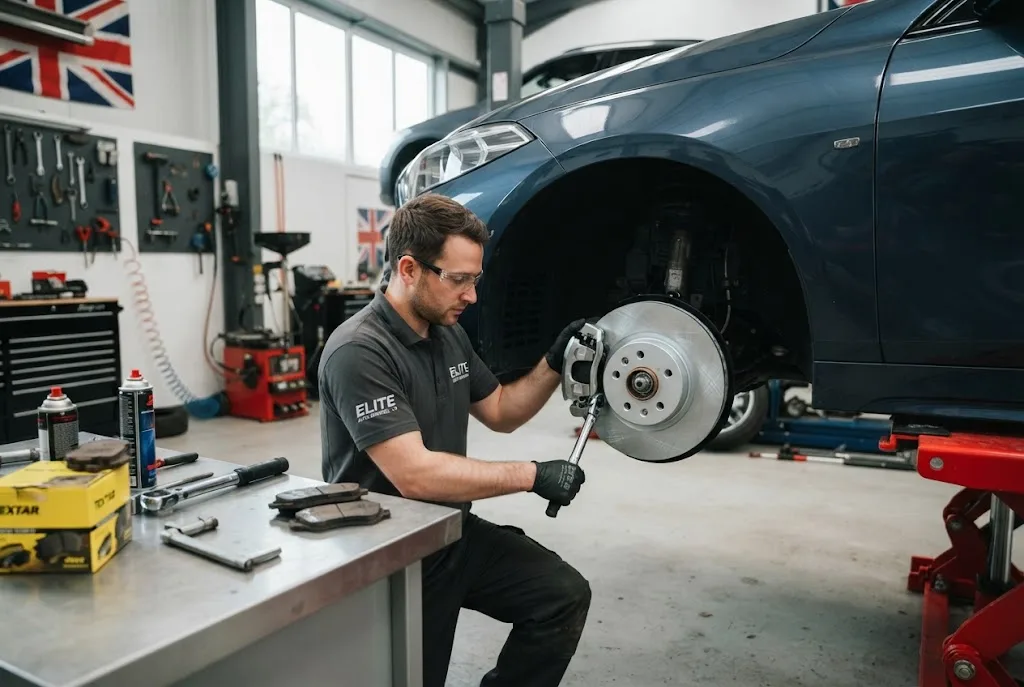
If your car is making unusual braking noises, taking longer to stop or producing vibration through the steering wheel, it may be time to investigate a brake pad and disc replacement. Brake pads and discs work together to create the friction needed to slow and stop a vehicle, so both components need to remain in suitable condition.
The cost of replacing brake pads and discs in the UK varies according to the vehicle, axle, parts selected, labour rate and location. RAC currently gives a general guide of around £200 to £500 per axle when both pads and discs are replaced, although individual vehicles can fall outside this range. This guide explains what the job involves, how much it can cost, the signs of worn brakes and how to compare quotes.
What Is Brake Pad and Disc Replacement?
A brake pad and disc replacement involves removing worn brake pads and brake discs and installing suitable replacement components. Brake pads press against the rotating discs when you apply the brake pedal, creating friction that slows the vehicle.
Both components experience wear, although brake pads generally wear faster than discs. When a disc becomes excessively worn, damaged, corroded or uneven, replacing the pads alone may not be appropriate.
A professional technician should inspect the complete braking system before deciding which parts need replacement. This can include the pads, discs, calipers, brake hoses and other related components.
How Much Does Brake Pad and Disc Replacement Cost?
The brake pad and disc replacement cost depends heavily on the vehicle and whether you are replacing components on the front axle, rear axle or both. RAC currently states that replacing both brake pads and discs can cost approximately £200 to £500 per axle, depending on the vehicle and parts used.
RAC’s recent vehicle-specific data illustrates how much prices can vary. Its 2026 guide gives an average of £357 for brake pads and discs across BMW models, while the average for Audi models is £391. These are RAC Mobile Mechanics figures and are not universal UK prices.
For this reason, asking simply about the brake installation price is not enough. A useful quotation should identify the vehicle, axle, parts, labour and any additional components that may be required.
What Affects the Cost of Replacing Brake Pads and Discs?
Several factors can make one brake job considerably more expensive than another.
Vehicle Make and Model
Different vehicles use different sizes and designs of brake components. Larger cars, performance vehicles and premium models can require more expensive parts.
For example, RAC’s current BMW data shows model-specific prices ranging from several hundred pounds for individual axles to more than £700 for front and rear replacement on some models.
Front or Rear Brakes
Front and rear braking systems can use different components. The front axle often experiences greater braking loads, while rear systems can have different designs depending on the vehicle.
Always confirm whether a quotation covers the front brakes, rear brakes or all four wheels.
Quality and Type of Parts
Replacement car brake parts are available at different price points. The correct specification and suitable quality are more important than choosing a component solely because it is inexpensive.
RAC notes that brake pad prices vary according to the vehicle and pad type, with materials including ceramic, semi-metallic and organic options.
Labour Costs
Garage labour rates differ across the UK. Location, workshop type and the complexity of the vehicle can all influence the final quotation.
Additional Components
Some vehicles use brake wear sensors or specific fitting hardware. If a caliper or another brake component is damaged or seized, additional work may also be necessary.
When Do Brake Pads and Discs Need Replacing?
There is no single mileage that applies to every vehicle. Brake wear depends on driving style, traffic conditions, vehicle weight, road gradients and how heavily the brakes are used.
RAC currently gives a general guide of around 20,000 to 40,000 miles for brake pads and approximately 50,000 to 80,000 miles for discs, while stressing that actual lifespan varies according to use.
Frequent stop-start driving, towing, carrying heavy loads and driving on hilly roads can increase brake wear. Regular inspections can therefore be more useful than relying on mileage alone.
Signs You May Need Brake Pads and Discs Replacement
Worn braking components can produce several warning signs. If you notice a change in braking performance, have the system inspected rather than waiting for the problem to become more severe.
Squealing or Grinding
Squealing can occur when brake pads become worn, although noise does not always mean that the pads need immediate replacement. Grinding is more concerning because it can indicate severe pad wear and contact between components that should not be directly rubbing together.
RAC identifies squealing and grinding as signs that brake pads may need inspection.
Longer Stopping Distances
If your vehicle appears to take longer to stop than it normally does, the braking system should be checked. Worn pads are one possible cause, but other faults can also affect braking performance.
Brake Vibration or Judder
Vibration when braking can indicate uneven braking surfaces or another issue affecting the braking system. RAC lists heavy vibration among the signs that can accompany worn brakes.
Vehicle Pulling to One Side
If the vehicle pulls left or right while braking, it should be inspected. Uneven brake operation can have several possible causes, so replacing parts without a proper diagnosis is not advisable.
Brake Warning Light
A brake warning light can indicate a problem requiring attention. Some vehicles also have dedicated brake-pad wear sensors that alert the driver when pad material reaches a specified level.
What Is the Difference Between Brake Pads and Discs?
Brake pads are friction components that press against the discs when the brakes are applied. The discs rotate with the wheel and provide the surface against which the pads create friction.
Because they perform different functions, they also wear differently. Brake pads are consumable components and are normally replaced more frequently than discs.
However, worn pads can eventually damage discs. RAC specifically warns that allowing pads to wear too far can cause damage to the discs and increase repair costs.
Should You Replace Brake Pads and Discs Together?
Not every brake service requires both components to be replaced. The correct approach is to inspect the condition of the pads and discs and follow the vehicle manufacturer’s specifications.
If the discs are worn, damaged or below their permitted specification, fitting new pads without addressing the discs may not be appropriate. Conversely, if the discs remain within specification and are in suitable condition, a technician may determine that only the pads require replacement.
This is why a professional inspection is important before agreeing to a complete brake discs and pads replacement.
How a Brake Job Is Carried Out
A typical brake job starts with safely securing the vehicle and removing the relevant wheel. The technician then inspects the braking components before removing the old pads and discs if replacement is required.
New components are installed according to the vehicle’s requirements. The technician checks the brake assembly, reinstalls the wheel and confirms that the braking system operates correctly.
Depending on the vehicle and the work being completed, additional components such as wear sensors or fitting hardware may need attention.
Once the work is complete, the braking system should be checked before the vehicle is returned to normal road use.
Can You Replace Brake Pads and Discs Yourself?
Some experienced vehicle owners choose to carry out their own brake work. However, brakes are a safety-critical system, and incorrect installation can have serious consequences.
The job requires suitable tools, safe vehicle support, compatible parts and an understanding of the specific braking system. Some vehicles also have electronic parking brakes, wear sensors or other systems that require additional procedures.
If you are not confident working on braking components, using a qualified mechanic is the safer approach.
How to Compare Brake Pad and Disc Replacement Quotes
When comparing quotes, make sure each garage is pricing the same job. A cheap headline figure may cover only brake pads, while another quotation may include both pads and discs.
Ask whether the quotation includes:
- Brake pads
- Brake discs
- Labour
- VAT
- Brake wear sensors where applicable
- Standard fitting hardware
- Removal and disposal of old components
- Inspection of the remaining brake components
RAC’s current guidance also recommends comparing detailed quotations because brake repair prices vary according to vehicle, parts and labour.
Brake Pads, Discs and Other Brake Maintenance
Brake pad and disc replacement should not be considered separately from the wider braking system. The Brake fluid, calipers, hoses and other components also need appropriate inspection and maintenance.
For example, if the brake pedal feels unusually soft, replacing pads and discs may not address the underlying issue. A separate brake fluid service may be required if the hydraulic system needs attention.
Similarly, braking performance can sometimes be affected by other vehicle maintenance issues. Keeping your wider maintenance schedule up to date can help identify problems before they develop into more expensive repairs.
Brake Installation Price: What Should You Expect?
The phrase brake installation price can refer to different types of work, so always clarify what is included. Installing brake pads only is different from replacing both pads and discs, and replacing components on one axle is different from replacing them on both.
For context, RAC currently reports that brake-pad-only replacement generally costs around £100 to £300 per axle including parts and labour. When discs are included, the cost rises because additional components and labour are involved.
The best quotation is therefore not necessarily the lowest headline figure. It is the quotation that clearly identifies the required work and uses components appropriate for your vehicle.
Final Thoughts on Brake Pad and Disc Replacement
A brake pad and disc replacement can become necessary when friction components reach the end of their serviceable life or when discs are damaged, worn or outside their permitted specification. Squealing, grinding, vibration, pulling and longer stopping distances can all justify a brake inspection.
The cost of replacing brake pads and discs varies considerably across the UK. RAC’s current guidance places a general combined replacement at around £200 to £500 per axle, while vehicle-specific data demonstrates that premium and larger vehicles can cost considerably more.
Before booking, confirm whether the quotation covers pads, discs, labour and VAT, and whether the work applies to the front, rear or both axles. Most importantly, do not ignore changes in braking performance. Prompt inspection can help identify worn components before they cause further damage.
Once your braking system has been assessed, it is also worth keeping other routine maintenance up to date, including wheel alignment and regular engine maintenance such as an oil change and filter replacement.