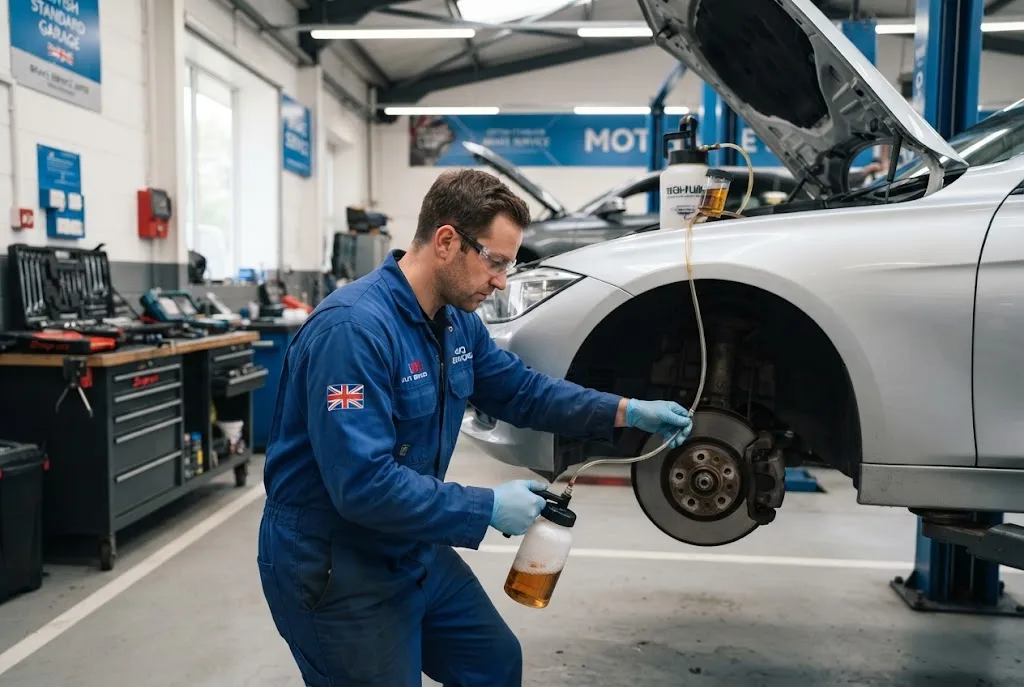
A brake fluid service is an important part of routine vehicle maintenance because your braking system relies on hydraulic fluid to transfer pressure from the brake pedal to the braking components. Over time, brake fluid can absorb moisture and become less effective, which is why manufacturers specify replacement intervals for many vehicles.
For UK drivers, understanding when brake fluid replacement is required can help prevent avoidable braking-system problems. The cost also varies according to the vehicle, fluid specification, garage and whether the work is completed as a standalone service or as part of a wider car service. This guide explains what brake fluid does, how much a service can cost, when the fluid should be replaced and the signs that your vehicle may need attention.
What Is a Brake Fluid Service?
A brake fluid service normally involves removing the existing brake fluid and replacing it with fresh fluid that meets the vehicle manufacturer’s specification. The system may then be bled to remove old fluid and unwanted air from the hydraulic circuits.
RAC describes a brake fluid change as a process that can involve removing fluid from the reservoir, refilling with fresh fluid, bleeding the brake circuits in the correct sequence and running sufficient fresh fluid through the system to remove contaminated fluid and air. Some vehicles may also require diagnostic equipment when working with certain ABS systems.
The exact procedure can therefore vary between vehicles. A professional technician should follow the manufacturer’s recommended procedure and use the correct brake fluid specification.
How Much Does Brake Fluid Service Cost in the UK?
The brake fluid service cost varies between garages and vehicles. RAC’s UK guide published in July 2026 states that a brake fluid change can cost from around £90, while larger or premium vehicles can cost more. RAC also notes that higher-quality fluid and replacement work can push the price above £120.
Prices can also be lower at some national service centres. For example, Halfords currently lists a brake fluid change at £54.99, with the final price subject to the selected vehicle and location. The service involves draining the old fluid and refilling with new brake fluid to the correct specification.
These examples show why there is no single fixed brakes fluid change cost across the UK. When requesting a quotation, give the garage your vehicle registration or exact make and model so the price can be calculated accurately.
What Affects Brake Fluid Service Cost?
Several factors can influence the price of a brake fluid replacement.
Vehicle Make and Model
Different cars can have different brake-system designs and manufacturer requirements. Premium, performance and specialist vehicles may require specific procedures or fluids, which can affect the final price.
Brake Fluid Specification
Brake fluid is not a one-size-fits-all product. The vehicle manufacturer’s specification should be followed when selecting replacement fluid. Using the wrong fluid can cause compatibility and braking-system problems.
Garage Labour Rates
Independent garages, national chains and mobile mechanics can have different labour rates. Location can also influence the price, particularly in areas where workshop operating costs are higher.
Standalone Service or Full Service
Brake fluid replacement may be available as an individual service or included within a larger maintenance package. Halfords, for example, includes brake fluid replacement in its major service offering.
Why Does Brake Fluid Need to Be Replaced?
Brake fluid is exposed to moisture over time. RAC explains that brake fluid absorbs moisture from the air, which can reduce its effectiveness and contribute to corrosion within the braking system.
Moisture can also affect the fluid’s boiling characteristics. Braking generates substantial heat, particularly during repeated or prolonged braking. If the fluid has deteriorated, its ability to cope with high temperatures can be affected.
Replacing old fluid helps maintain the hydraulic system according to the vehicle manufacturer’s maintenance requirements. It should not, however, be viewed as a substitute for inspecting worn brake pads, discs, calipers or other braking components.
How Often Should Brake Fluid Be Changed?
There is no universal interval that applies to every vehicle. Your owner’s handbook or manufacturer’s servicing information should take priority.
As a general reference, Halfords says most manufacturers recommend changing brake fluid every 24 months or 24,000 miles, whichever comes first. RAC similarly reports a two-year or 24,000-mile interval in its current UK guide, while noting that requirements can vary according to make, model, fluid quality and driving conditions.
Some vehicles can have different schedules, so do not assume that every car needs exactly the same interval. If you are unsure, check the manufacturer’s servicing schedule or ask a qualified technician to confirm when your vehicle is due.
Signs Your Car May Need Brake Fluid Replacement
A vehicle does not always provide an obvious warning when brake fluid has reached the end of its recommended service interval. However, there are symptoms that should encourage you to have the braking system inspected.
Soft or Spongy Brake Pedal
A brake pedal that feels unusually soft or spongy can indicate a problem within the hydraulic braking system. Air in the system, deteriorated fluid or another brake-system fault may contribute to this sensation.
Reduced Braking Performance
If your brakes do not feel as responsive as usual, arrange an inspection rather than assuming that a simple fluid replacement will solve the problem. Worn pads, discs, hydraulic faults and other issues can produce similar symptoms.
Longer Stopping Distance
An unexpected increase in stopping distance should always be taken seriously. Halfords identifies reduced braking performance and a longer stopping distance among signs that brake fluid may need attention.
Brake Warning Light
A warning light on the dashboard can indicate a low fluid level or another braking-system problem. Do not ignore a brake warning light simply because the vehicle continues to drive normally.
What Happens During a Brake Fluid Replacement?
The exact procedure depends on the vehicle, but a professional brake fluid replacement generally involves several stages.
- The technician checks the vehicle and braking system.
- The old brake fluid is removed from the appropriate part of the system.
- Fresh brake fluid meeting the required specification is added.
- The brake circuits are bled according to the manufacturer’s procedure.
- The system is checked for appropriate fluid level and operation.
- Old fluid is collected and disposed of appropriately.
On vehicles with advanced braking or ABS systems, additional procedures or diagnostic equipment may be required. This is one reason why a professional service is preferable to relying on a generic procedure for every vehicle.
Brake Fluid Top-Up vs Brake Fluid Service
A brake fluid top-up and a complete brake fluid replacement are not the same thing.
A top-up adds fluid when the reservoir level is low. A service or flush involves removing old fluid and replacing it with fresh fluid. If the fluid is due for replacement, simply adding more fluid does not renew the fluid throughout the hydraulic system.
A low brake fluid level can also indicate that the brake system needs inspection. Depending on the vehicle, it can be associated with brake-pad wear, a leak or another issue. Therefore, drivers should not repeatedly top up fluid without finding out why the level has fallen.
Is Brake Oil for a Car the Same as Engine Oil?
The term brake oil for car is sometimes used informally, but brake fluid and engine oil are completely different products.
Brake fluid is a hydraulic fluid used in the braking system. Engine oil lubricates and protects moving engine components. They have different chemical properties, specifications and purposes.
Never substitute engine oil for brake fluid or use a product simply because its packaging appears similar. Always use the fluid specified for your particular braking system.
What About BMW Brake Fluid Service?
A BMW brake fluid service follows the same fundamental principle as brake fluid maintenance on other vehicles: the existing fluid is replaced with fluid that meets the vehicle’s requirements.
However, the exact procedure, fluid specification and service schedule can vary by BMW model and year. Drivers should therefore check their vehicle’s service information rather than relying on a generic interval.
This also means that a BMW brake fluid service cost cannot be accurately stated as one universal figure. Parts, fluid, labour, location and the specific BMW model can all affect the quotation.
Can Brake Fluid Be Changed at Home?
Brake fluid replacement is technically possible for an experienced person with the appropriate equipment and knowledge, but it is not a maintenance job to approach casually.
The braking system needs to be bled correctly, the appropriate fluid must be used and contaminated fluid must be removed safely. Some vehicles also require vehicle-specific procedures or diagnostic equipment.
Because brakes are a critical safety system, many drivers choose to have brake fluid replacement carried out by a qualified technician. RAC also recommends that the procedure is carried out by a mobile mechanic or trusted garage because of the care required during the process.
Brake Fluid Service vs Other Brake Maintenance
Brake fluid maintenance is only one part of looking after a vehicle’s braking system. The Brake pads, discs, calipers, hoses and other components can also require inspection or replacement.
For example, if the brake pads have reached the end of their usable life, replacing the fluid alone will not resolve the problem. Drivers should also understand the difference between hydraulic fluid maintenance and physical brake-component replacement.
If your vehicle requires wider brake work, you may need a separate brake pad and disc replacement. Keeping these maintenance jobs distinct makes it easier to understand what work your car actually needs.
How to Choose a Brake Fluid Service
When comparing garages, do not look only at the advertised price. Ask which brake fluid specification will be used, whether the quotation includes labour and whether the price covers a complete replacement and bleeding procedure.
It is also worth asking whether the work is being completed as part of a larger service. Some service packages include brake fluid replacement, meaning that paying separately for the same work may not be necessary.
Most importantly, make sure the garage has the correct vehicle information. This allows the technician to follow the appropriate manufacturer requirements rather than applying a generic procedure.
Final Thoughts on Brake Fluid Service
A brake fluid service is an important maintenance task that helps keep a vehicle’s hydraulic braking system operating according to manufacturer requirements. Brake fluid can absorb moisture over time, which is why many manufacturers specify periodic replacement.
The brake fluid service cost varies considerably. Current UK examples range from lower-cost national service-centre pricing to higher prices for larger or premium vehicles. The most useful quotation is therefore one based on your exact vehicle, location and required brake fluid specification.
Do not confuse a brake fluid replacement with a simple top-up, and do not assume that a fluid change will fix every braking problem. If the pedal feels spongy, stopping distances increase, a warning light appears or braking performance changes, have the complete system inspected.
Regular brake maintenance should also be considered alongside other essential vehicle checks. Once your fluid is up to date, you can continue reviewing other areas of your car maintenance schedule, including engine oil and filter changes, brake components and wheel alignment.