Every gaming setup reaches the same fork in the road sooner or later: the gaming headset vs speakers decision. Sound is half the experience of a good game, yet it is often the last part of the setup people think about. A headset wraps the audio around you and keeps the rest of the house quiet. Speakers fill the room and let everyone share what is happening on screen. Neither is simply better — the right choice depends on how you play, where you play, and who else is in the room while you do it. This guide walks through the honest strengths and weaknesses of each option so you can spend money once and be happy with the result.
What a Gaming Headset Does Best
A headset’s biggest advantage is focus. With the drivers sitting directly over your ears, small details that would vanish into a room — footsteps on a floor above you, a distant reload, the direction of an engine note — stay clear and easy to place. In competitive games that positional information is genuinely useful, and even in relaxed single-player titles it pulls you deeper into the world. Headsets also win on consideration: you can play at full volume at midnight without waking anyone, which matters in shared houses and flats.
There is a social side too. Most gaming headsets include a microphone positioned close to your mouth, so your voice comes through clearly to teammates without the room echo that a desk microphone picks up. If you regularly play online with friends, that built-in microphone alone can justify the purchase. Our guide to choosing a used mini gaming PC makes a similar point about compact setups: when space and noise are limited, gear that keeps everything close and contained tends to work best.
Where Speakers Win
Speakers are the natural choice when gaming is a shared activity. Two people on a sofa cannot share one headset, but a decent pair of speakers turns the screen into something closer to a cinema. Sports games, racing titles and story-driven adventures all feel bigger when the sound has room to breathe, and anyone watching gets the full experience rather than muffled spill from someone else’s earcups.
Comfort is the other quiet victory. Nothing presses on your ears, nothing traps heat, and there is no headset hair after a long session. If you play for hours at a time, or you wear glasses that dig in under tight earcups, speakers remove a whole category of small annoyances. They also double up for everything else you do at the desk — films, video calls, music while you work — without swapping devices. It is the same reason many people prefer a proper screen for long sessions, something we covered when explaining how to choose a gaming monitor: the setup you sit at for hours should be comfortable first and impressive second.
Sound Quality and Positional Audio Compared
At the same budget, a good headset usually delivers more detail per pound than speakers, simply because it does not have to fight the room. Speaker sound is shaped by your walls, desk and furnishings; a bare room with hard surfaces can make even capable speakers sound harsh and echoey. Headsets sidestep all of that, and modern surround processing can create a convincing sense of space from two small drivers.
Speakers answer back with a wider, more natural soundstage. Music and ambient audio feel less like they are happening inside your head, and bass has a physical presence that headphones struggle to copy. Explosions thump rather than just hum. If your games are mostly cinematic adventures rather than competitive shooters, that open, room-filling character may matter more to you than picking out a footstep two rooms away. The history of how game audio reached this point is fascinating — we looked at how physical media shaped it in our piece on media for PC games.
Comfort, Space and Your Room
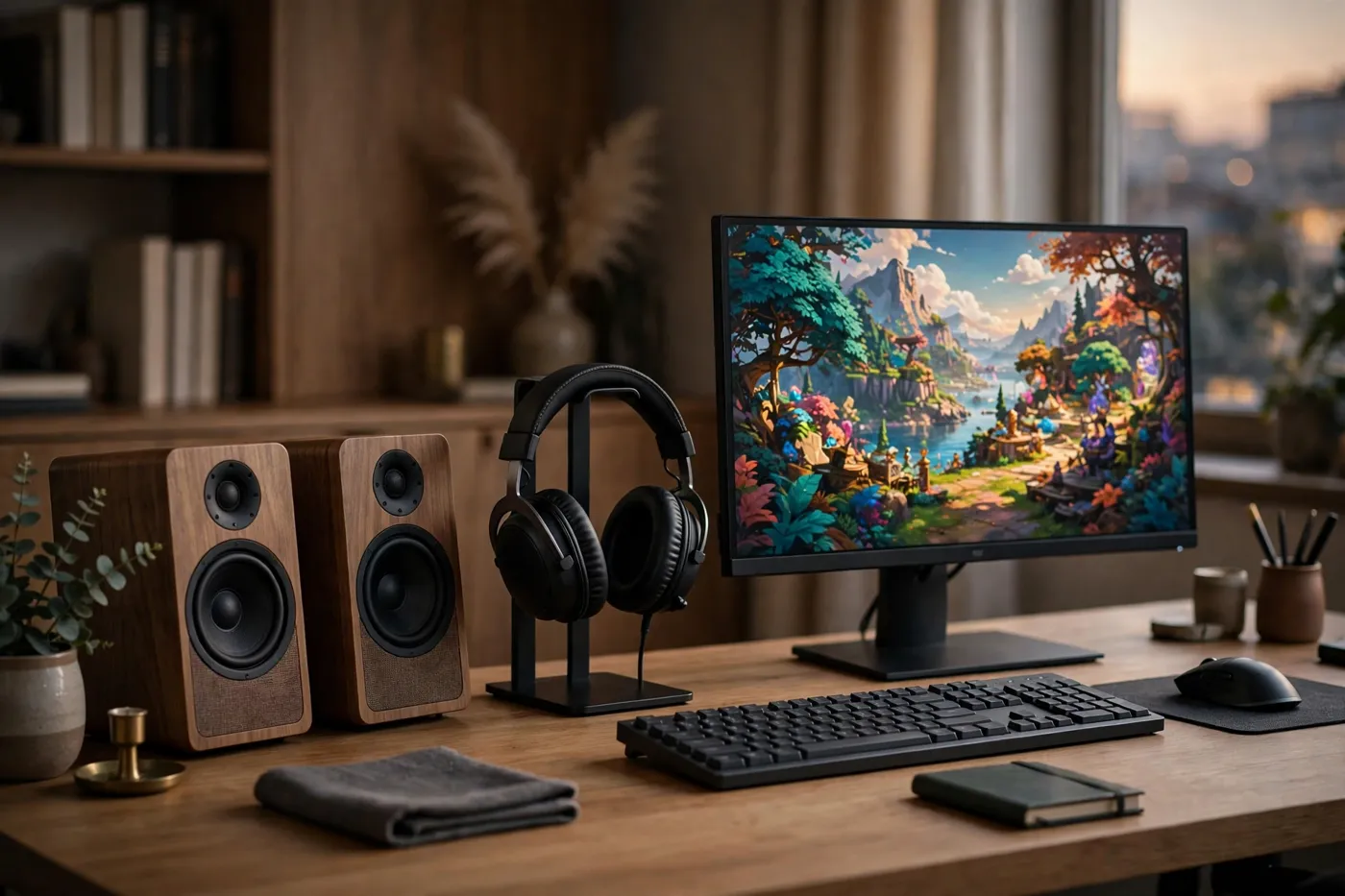
Be honest about your space before you buy. A headset needs a hook or a corner of the desk and nothing more. Speakers need placement — ideally either side of your screen, at ear height, with a little distance from the wall — and they need the room to tolerate the volume you want. Thin walls and sleeping children are strong arguments for the headset column. A dedicated gaming room or a living-room TV setup points just as firmly towards speakers.
Cables and clutter count too. A wireless headset removes the cable but adds charging to your routine and a battery that will age. Speakers mostly sit still and ask for nothing once they are wired in, which is why they pair well with a tidy, permanent desk. If your setup shares space with the rest of the home, our beginner’s guide to smart home devices covers similar trade-offs between convenience and simplicity elsewhere in the house.
The Microphone Question
If you play online with other people, the microphone may decide this for you. A headset microphone sits centimetres from your mouth, rejects most background noise, and mutes with a flip or a button. With speakers, your voice chat needs a separate microphone, and that microphone will also hear your speakers unless you carefully manage volumes and use push-to-talk — otherwise your teammates get an echo of the game every time you speak.
Solo players can ignore this entirely. If your gaming is single-player, or your group chats happen on a phone beside you, the microphone stops being a factor and the decision comes back to comfort, space and sound character.
Cost and Value for Money
Resist comparing headline prices alone; compare what the full working setup costs. A headset is one purchase that covers listening and talking. A speaker setup with voice chat needs the speakers plus a microphone, and possibly stands or a small amplifier depending on what you choose. On the other hand, speakers are buy-once items with no batteries to degrade, and they serve the whole household rather than one person. Console players should also check compatibility before buying either — platform support for audio devices varies, a theme we touched on when looking at the heart of Nintendo’s new console.
A Simple Way to Decide
Ask yourself four questions. Do you play late at night or in a shared space? Choose a headset. Do other people watch or join in from the same room? Choose speakers. Do you voice-chat with a regular team? Choose a headset, or budget for a separate microphone. Do you play long sessions and hate wearing things on your head? Choose speakers. Most people find three of the four answers point the same way — and that is your answer.
Can You Use Both?
Plenty of players end up with both, and it is not the extravagance it sounds. A modest headset for online nights and a modest set of speakers for everything else can cost less than one premium product trying to do both jobs. Switching takes seconds on most systems, and each device gets used where it is strongest. If your budget only stretches to one purchase this year, buy for the way you play most often, and add the second when a good opportunity appears.
Whichever side of the gaming headset vs speakers debate you land on, the real mistake is ignoring audio altogether and playing through thin monitor or laptop speakers. Both upgrades transform how games feel. Pick the one that fits your room, your hours and your habits — and you will wonder why you waited so long to sort it out.